Tri-tip slicing fix
Tri-tip slicing the wrong direction ruins the whole cook
Published June 5, 2026
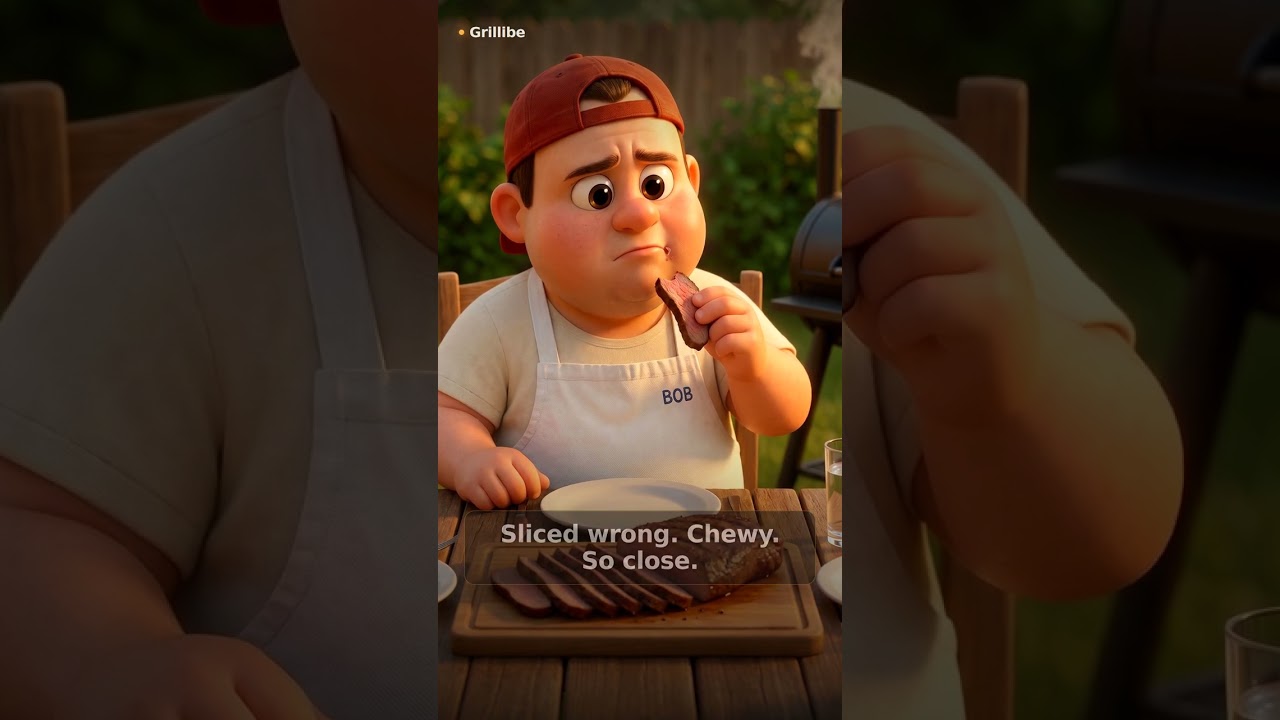
You pulled your tri-tip off the grill at a perfect 130 F, rested it, and sliced it up. But every bite was tough and stringy instead of tender. The cook was fine. The problem was the knife work. Tri-tip has a grain that runs in two different directions, and slicing with the grain instead of against it is the single most common reason a great cook ends up with chewy meat.
Affiliate disclosure: Grillibe may earn a commission from links on this page. We only recommend BBQ gear that fits the cook, problem, or beginner setup.
Quick answer
Always slice tri-tip against the grain, not with it. The grain on a tri-tip changes direction roughly in the middle of the roast, so you need to split the cut into two sections and rotate your knife for each one. Slice at about a 90-degree angle to the muscle fibers, in pieces 1/4 to 3/8 inch thick. Do this and even a medium-well tri-tip will eat tender.
Why slicing direction matters so much on tri-tip
Muscle fibers in beef run in long strands. When you slice with the grain, you leave those strands long, and your teeth have to do all the work of breaking them apart. That is why the meat feels chewy and stringy even when it is cooked to the right temperature.
Slicing against the grain cuts those fibers short. Instead of chewing through a long strand, you are biting through dozens of short ones. The difference in texture is dramatic. This is true for any steak, but it matters more on tri-tip because the grain runs in two directions across a single roast, which catches a lot of cooks off guard.
How to find the grain on a tri-tip
Before you cook, look at the raw roast. You can see the muscle fibers running lengthwise across the surface. On a tri-tip, the grain in the thick top section runs roughly from the point toward the center. In the thinner bottom section, the grain turns and runs at a different angle, usually about 45 to 90 degrees from the first direction.
If you are having trouble seeing it on the raw meat, it becomes much easier after cooking. The fibers open up slightly and the lines are clearer. Flip, Grillibe's smoke-spirit, calls this the "grain reveal" moment, and it is worth taking 10 seconds to trace the lines with your finger before you make your first cut.
The two-section slicing method
Because the grain changes direction, you need to treat a tri-tip as two separate cuts at the carving board. Find where the grain shifts, usually somewhere near the center of the roast, and make one straight cut there to divide the roast into two pieces.
Then slice each piece separately, always cutting perpendicular to the grain lines in that section. Bob's mistake was slicing straight through the whole roast in one direction without stopping. Half his slices were against the grain and came out great. The other half were with the grain and were tough. Splitting the roast first solves this completely.
- 1Rest the cooked tri-tip for 10 to 15 minutes before cutting. This lets juices redistribute so they do not run out when you slice.
- 2Set the roast on a cutting board with the point facing you.
- 3Trace the grain lines with your finger on both the top and bottom sections of the roast.
- 4Find where the grain direction changes and make one straight cut to divide the roast into two pieces.
- 5Slice the thick section against its grain in 1/4 to 3/8 inch pieces, cutting at roughly 90 degrees to the fiber lines.
- 6Rotate the second (thinner) piece so you can again cut against its grain, and slice it the same way.
- 7Fan the slices on a platter and serve immediately.
Thickness and angle make a real difference
Even when you cut against the grain, slice thickness changes the eating experience. Slices thinner than 1/4 inch can dry out fast and lose their juiciness on the platter. Slices thicker than 1/2 inch start to feel chunky and can still have some chew because the fibers, though short, are stacked deeper.
The sweet spot is 1/4 to 3/8 inch. A sharp slicing knife or a long chef's knife makes this easier than a short blade. You want to draw the knife through in one smooth pull rather than sawing back and forth, which tears the fibers instead of cutting them cleanly. ThermoWorks has a good breakdown of how meat fiber structure affects texture if you want to go deeper on the science.
Get the cook right before you worry about the slice
Slicing correctly fixes texture, but it cannot rescue overcooked meat. Tri-tip is best pulled from the grill at 125 F for medium-rare or 135 F for medium, then rested. The carry-over heat will bring it up another 3 to 5 degrees during the rest. Going past 145 F internal makes the muscle fibers contract and squeeze out moisture, and no amount of correct slicing will bring that back.
If you want a method that gives you the most control over that final temperature, the reverse sear approach works extremely well on tri-tip. You bring the roast up slowly in a low oven or smoker, then sear it hard at the end. It also gives you a longer rest window, which means the grain lines are easier to read before you cut. For more on reading and managing beef temps, the USDA food safety guidelines are worth a quick read.
Short-form angle
Show a raw tri-tip, trace the two grain directions with a finger, then slice one section wrong and one section right and pull the pieces apart to show the texture difference side by side.
FAQ
Why is my tri-tip chewy even though I cooked it to the right temp?
Almost always it is a slicing problem, not a cooking problem. If you sliced with the grain instead of against it, the muscle fibers stay long and your teeth have to tear through them. Divide the roast into two sections at the point where the grain changes direction, then slice each section against its own grain in 1/4 to 3/8 inch pieces.
How do I know which direction the grain runs on a tri-tip?
Look for the long parallel lines running across the surface of the meat. On a tri-tip, those lines run one direction in the thick top section and shift to a different angle in the thinner bottom section. After cooking and resting, the lines are easier to see. Trace them with your finger before you cut.
Do I really need to cut a tri-tip into two pieces before slicing?
Yes, if you want every slice to be against the grain. The grain changes direction in the middle of the roast, so slicing straight through in one direction means half your slices will be with the grain and will be chewy. One cut to split the roast takes five seconds and fixes the problem entirely.
How thick should tri-tip slices be?
Aim for 1/4 to 3/8 inch thick. Thinner than 1/4 inch and the slices dry out quickly on the platter. Thicker than 1/2 inch and you start to get chew again even when you are cutting against the grain. Use a long, sharp knife and draw it through in one smooth pull rather than sawing.
Does resting tri-tip before slicing actually matter?
Yes. Rest the roast for 10 to 15 minutes after pulling it from the heat. During that time the muscle fibers relax and reabsorb some of the juices that were pushed toward the center during cooking. If you cut immediately, those juices run straight out onto the board and the meat ends up drier.